
Katakana H–W Rows
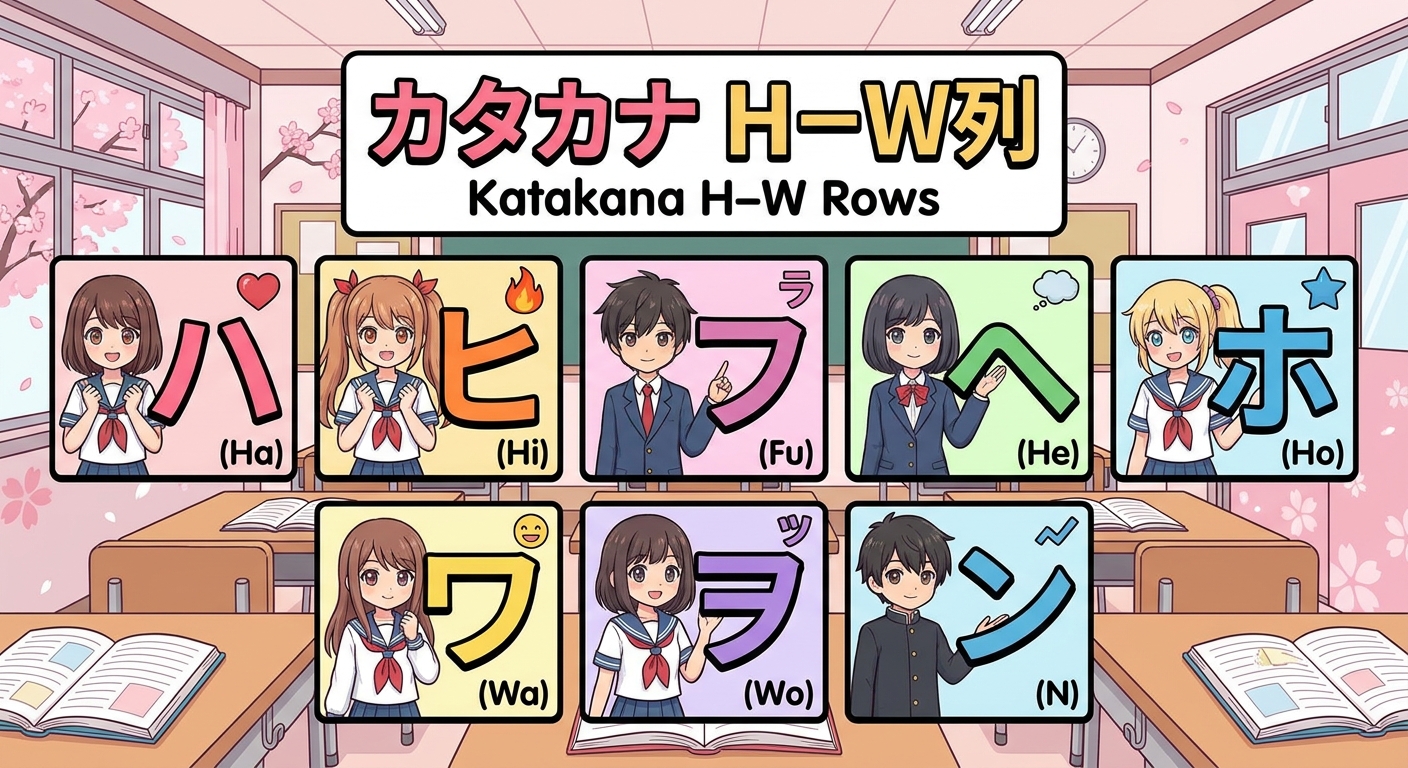
Learn ハ to ワ and ン. Understand long vowels written with ー. Read common loanwords like コーヒー and テレビ.
🎯 Goal: To accurately read, write, and pronounce all Katakana characters from the H through W rows, distinguish visually similar characters, and recognize common loanwords utilizing these characters to build foundational N5 literacy.
Introduction
Welcome to the final stage of your Katakana journey! In this lesson, we will cover the H, M, Y, R, and W rows, along with the unique singular consonant "n" (ン). Mastering these final characters is a major milestone in your Japanese N5 studies, as it unlocks your ability to read and write countless foreign loanwords, non-Japanese names, and expressive onomatopoeia. We will focus on stroke order, visual distinctions between similar characters, and practical vocabulary. By completing these rows, you will have a fully functional Katakana repertoire, paving the way for confident reading comprehension.
Lesson Content
Master Katakana: The H–W Rows & Beyond (N5)
Welcome to the final stretch of your Katakana journey! As your tutor, I am thrilled to guide you through the H, M, Y, R, and W rows, plus the singular nasal consonant ン (n).
Katakana is primarily used for foreign loanwords, onomatopoeia, and emphasis. Mastering these final rows will instantly unlock your ability to read menus, signs, and everyday Japanese. Let’s dive in!
1. The H–W Katakana Chart
| Row | -a | -i | -u | -e | -o |
|---|---|---|---|---|---|
| H-row | ハ (ha) | ヒ (hi) | フ (fu) | ヘ (he) | ホ (ho) |
| M-row | マ (ma) | ミ (mi) | ム (mu) | メ (me) | モ (mo) |
| Y-row | ヤ (ya) | — | ユ (yu) | — | ヨ (yo) |
| R-row | ラ (ra) | リ (ri) | ル (ru) | レ (re) | ロ (ro) |
| W/N-row | ワ (wa) | — | — | — | ヲ (wo) / ン (n) |
2. Tutor’s Tips: Stroke Order & Visual Pitfalls
Katakana characters are sharp, angular, and highly geometric. Precision in stroke order and direction is crucial to avoid illegible handwriting.
⚠️ The Ultimate Confusion: ソ (so) vs. ン (n)
These two are the bane of N5 students. The secret lies in the direction of the long stroke:
- ソ (so): The first short stroke is vertical-ish. The second stroke starts from the top-right and sweeps down to the bottom-left. (Think of gravity falling down).
- ン (n): The first stroke is horizontal-ish. The second stroke starts from the bottom-left and sweeps up toward the top-right.
⚠️ The "Family" of フ (fu), ワ (wa), and ウ (u)
- フ (fu): A simple hook. (1 stroke)
- ワ (wa): Add a vertical left side to the hook. (2 strokes)
- ウ (u): Add a vertical cap on top of ワ. (3 strokes)
3. Stroke Order Highlights
- ハ (ha): Left stroke down, then right stroke down. Do not let them touch! (Similar to the kanji for eight: 八).
- マ (ma): Draw the top angle first (one continuous stroke), then add the small bottom stroke.
- ヨ (yo): Like a backward capital "E". Draw the top and middle bars first, then finish with the bottom L-shape.
- ル (ru): Left leg curves down-left; right leg goes down, hooks up to the right.
4. Real-World N5 Vocabulary Practice
Let's put your new knowledge to work. Try reading these common loanwords aloud:
- ハム (hamu) — Ham
- マフラー (mafurā) — Scarf / Muffler (Note: The ー indicates a long vowel sound).
- ヨーグルト (yōguruto) — Yogurt
- ラーメン (rāmen) — Ramen (Uses ラ, ー, メ, and ン!)
- ワイシャツ (waishatsu) — White shirt / Dress shirt (Uses the small ツ for a double consonant and small ュ for the sha sound).
5. Quick Check Challenge
Exercise: Translate these English words into Katakana using the characters you learned today.
-
"Hotel" (Hint: Ho-te-ru)
-
Answer: ホテル
-
"Camera" (Hint: Ka-me-ra)
-
Answer: カメラ
-
"Wine" (Hint: Wa-i-n)
-
Answer: ワイン
Keep practicing your stroke directions, and you will master N5 Katakana in no time! がんばってください (Good luck)!
Exercises
Katakana H–W Rows (Exercises)
Exercises for Katakana H–W Rows
Review the grammar and vocabulary, and try to fill in the blanks or write sentences based on the prompts.
Examples
あのホテルはとてもきれいです。
Ano hoteru wa totemo kirei desu.
That hotel is very beautiful.
私はワインを飲みます。
Watashi wa wain o nomimasu.
I drink wine.
新しいカメラを買いました。
Atarashii kamera o kaimashita.
I bought a new camera.
Practice Drills
Lesson Materials
Vocabulary (5)
Grammar (3)
Kanji (0)
No kanji characters in this lesson.
Kana (0)
No kana characters in this lesson.