
Foreign Words in Japanese
Learn the most common loanwords (外来語) used in daily Japanese: コーヒー (coffee), テレビ (TV), ホテル (hotel), スマホ (smartphone). Understand the patterns of sound conversion from English to Japanese.
🎯 Goal: By the end of this lesson, you will be able to identify, pronounce, and write common Katakana loanwords (Gairaigo) required for the JLPT N5 exam, and apply basic phonetic rules to convert familiar English words into their Japanese equivalents.
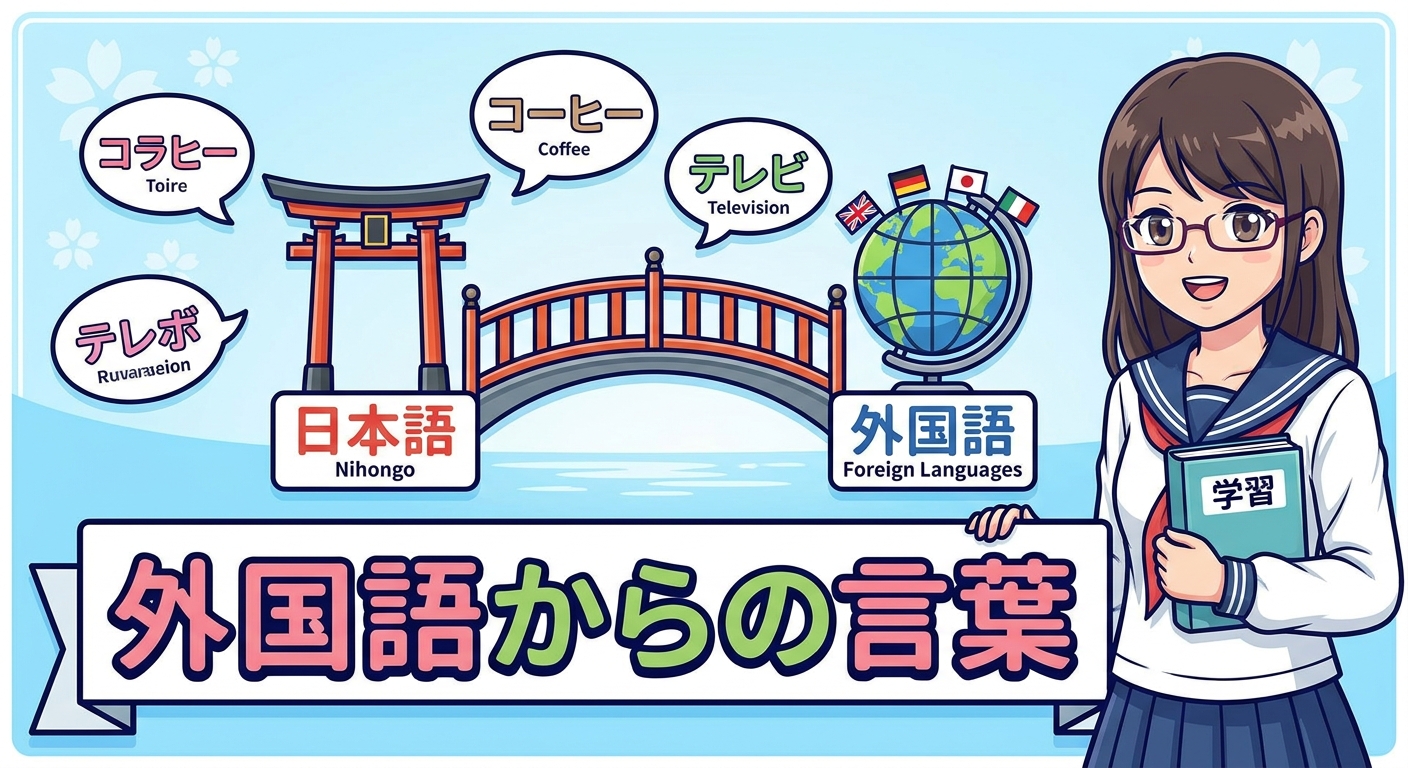
Introduction
Welcome to the fascinating world of Gairaigo (loanwords) in Japanese! Did you know that you already know hundreds of Japanese words? In this lesson, we will explore how Japanese adopts words from other languages—primarily English—and writes them using the Katakana alphabet. You will learn the phonetic rules that transform familiar words like 'camera' into 'kamera' and 'computer' into 'konpyuuta'. Mastering these pronunciation shifts is a powerful shortcut to rapidly expanding your N5 vocabulary, boosting your listening comprehension, and helping you navigate daily life in Japan with ease.
Lesson Content
Master Japanese N5: Foreign Words (外来語 - Gairaigo)
Welcome to your ultimate guide to Gairaigo (外来語)—foreign loanwords in Japanese!
As an N5 student, you have a secret weapon: thousands of Japanese words actually come from English, Portuguese, Dutch, and German. To write these words, Japanese uses the Katakana (カタカナ) alphabet.
In this guide, you will learn how foreign words are adapted, how to write them, and how to use them in everyday N5 grammar.
1. The Golden Rules of Katakana Pronunciation
Japanese syllables almost always end in a vowel (A, I, U, E, O). Because English words often end in consonants, Japanese "Japanizes" them by adding vowels.
Rule A: The Vowel Cushion
- If an English word ends in a consonant, Japanese usually adds "u" (or "o" for 't' and 'd').
- Post $\rightarrow$ ポスト (posuto)
- Bag $\rightarrow$ バッグ (baggu)
Rule B: The Long Vowel Mark (ー)
To represent long English vowels, Katakana uses a straight line called a Chōonpu (長音符).
- Stroke Order Tip: Write this line from left to right in horizontal writing, and top to bottom in vertical writing.
- Taxi $\rightarrow$ タクシー (takushī)
- Supermarket $\rightarrow$ スーパー (sūpā)
Rule C: Double Consonants (The Small ッ)
The small ッ (tsu) represents a sudden pause before the next consonant (a double consonant in English).
- Cup $\rightarrow$ コップ (koppu)
- Bed $\rightarrow$ ベッド (beddo)
2. Essential N5 Gairaigo Vocabulary
Here are the most common loanwords you must know for the JLPT N5 exam:
| Katakana | Romaji | English Origin | Meaning |
|---|---|---|---|
| テレビ | terebi | Television | TV |
| カメラ | kamera | Camera | Camera |
| トイレ | toire | Toilet | Restroom / Toilet |
| コーヒー | kōhī | Coffee | Coffee |
| パン | pan | Pão (Portuguese) | Bread |
| ホテル | hoteru | Hotel | Hotel |
| ノート | nōto | Notebook | Notebook |
Katakana Writing Tip: Watch out for シ (shi) vs. ツ (tsu)!
- For シ (shi), write the two small strokes horizontally, and stroke the long line from bottom to top.
- For ツ (tsu), write the two small strokes vertically, and stroke the long line from top to bottom.
3. Grammar: Using Gairaigo in Sentences
Gairaigo words function grammatically just like regular Japanese nouns.
Pattern 1: Direct Object + Particle を (o) + Verb
To do something to a foreign object, use the object particle を.
- コーヒーを飲みます。
- Kōhī o nomimasu.
- I drink coffee.
- カメラを買いました。
- Kamera o kaimashita.
- I bought a camera.
Pattern 2: Making Verbs with する (suru)
You can turn many English nouns into Japanese verbs simply by adding する (to do).
- コピー (Copy) + する $\rightarrow$ コピーする (To copy)
- テスト (Test) + する $\rightarrow$ テストする (To test/take a test)
Example:
レポートをコピーします。
Repōto o kopī shimasu.
I will copy the report.
4. Cultural Nuance: "Wasei-Eigo" (Made-in-Japan English)
Be careful! Some Katakana words look like English but have different meanings in Japan. These are called Wasei-Eigo (和製英語).
- マンション (manshon): Does not mean a luxury mansion; it means a standard apartment/condominium.
- スマート (sumāto): Does not mean smart (intelligent); it means slim/slender.
Quick Check!
Test your knowledge by translating these sentences into Japanese:
- I will write in the notebook. (Hint: Use the particle に for "in/on" and 書きます [kakimasu] for "write").
- This is a hotel. (Hint: Use これは [kore wa] and です [desu]).
Answers:
- ノートに書きます。 (Nōto ni kakimasu.)
- これはホテルです。 (Kore wa hoteru desu.)
Exercises
Foreign Words in Japanese (Exercises)
Exercises for Foreign Words in Japanese
Review the grammar and vocabulary, and try to fill in the blanks or write sentences based on the prompts.
Examples
毎朝、コーヒーを飲みます。
Maiasa, kōhī o nomimasu.
I drink coffee every morning.
これは新しいカメラです。
Kore wa atarashii kamera desu.
This is a new camera.
トイレはどこですか。
Toire wa doko desu ka.
Where is the restroom?
Practice Drills
Lesson Materials
Vocabulary (5)
Grammar (3)
Kanji (0)
No kanji characters in this lesson.
Kana (0)
No kana characters in this lesson.