
Katakana A–N Rows
Learn ア to ノ with correct stroke order. Compare katakana to their hiragana counterparts. Practice reading foreign words.
🎯 Goal: By the end of this lesson, you will be able to accurately identify, read, and write all 25 characters from the Katakana A, Ka, Sa, Ta, and Na rows, understand their stroke order, and decode basic loanwords using these characters.
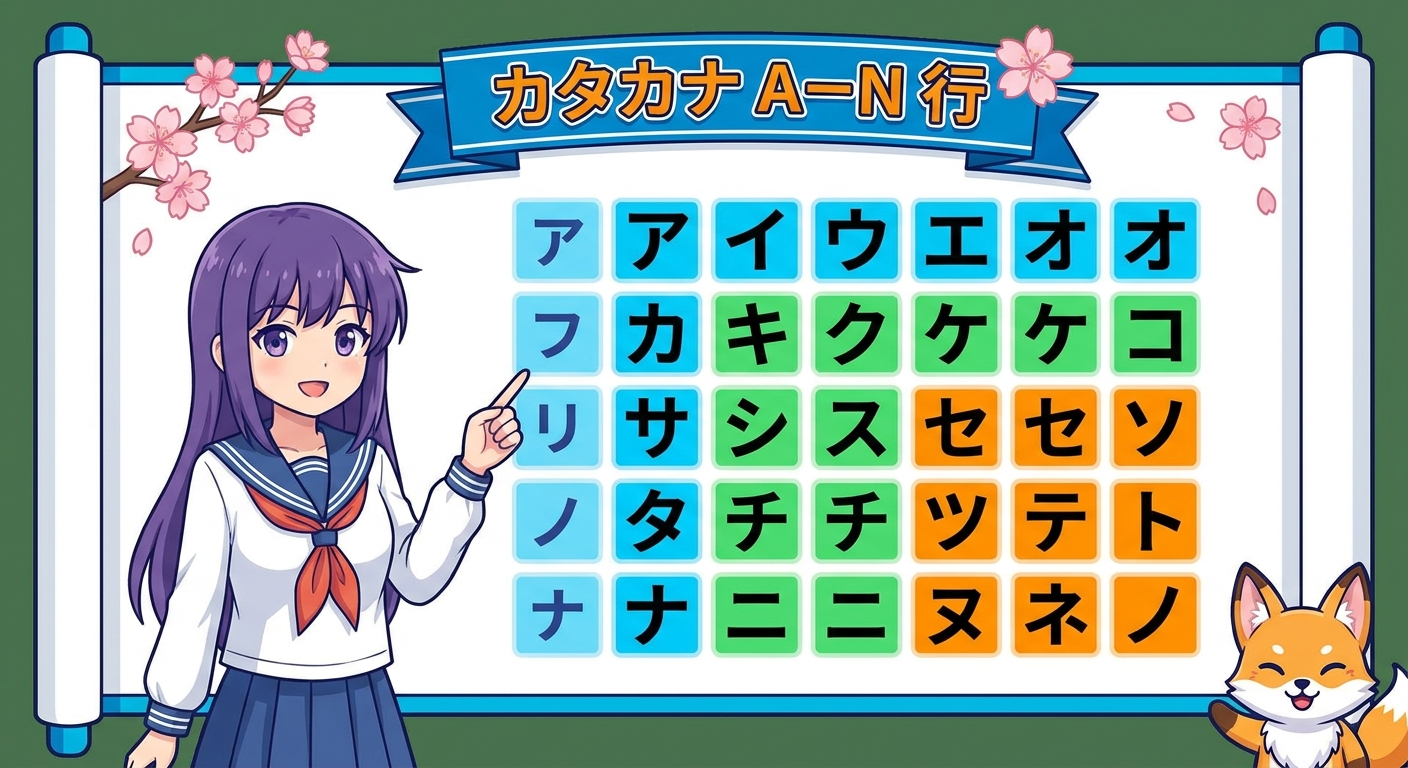
Introduction
Welcome to your essential guide to Katakana, one of the three foundational writing systems in Japanese. While Hiragana is used for native words, Katakana is crucial for reading foreign loanwords, technical terms, and non-Japanese names—elements you will encounter constantly in daily life and on the JLPT N5 exam. In this lesson, we will systematically cover the first five consonant rows: the A (ア), Ka (カ), Sa (サ), Ta (タ), and Na (ナ) rows. You will learn to recognize their distinct, angular stroke shapes, practice correct stroke order, and master the foundational building blocks of Katakana.
Lesson Content
Elite Japanese Study Guide: Mastering Katakana (ア to ン)
Welcome to your definitive guide to mastering Katakana (カタカナ). While Hiragana is used for native Japanese words and grammar particles, Katakana is your gateway to modern Japanese. It is used for foreign loanwords (gairaigo), country names, onomatopoeia, and emphasis.
By mastering the 46 basic characters from ア (A) to ン (N), you will instantly unlock the ability to read thousands of Japanese words.
1. The Katakana Character Map (ア to ン)
Unlike the soft, curvy strokes of Hiragana, Katakana characters are sharp, angular, and straight.
| Row | a-column | i-column | u-column | e-column | o-column |
|---|---|---|---|---|---|
| A | ア (a) | イ (i) | ウ (u) | エ (e) | オ (o) |
| Ka | カ (ka) | キ (ki) | ク (ku) | ケ (ke) | コ (ko) |
| Sa | サ (sa) | シ (shi) | ス (su) | セ (se) | ソ (so) |
| Ta | タ (ta) | チ (chi) | ツ (tsu) | テ (te) | ト (to) |
| Na | ナ (na) | ニ (ni) | ヌ (nu) | ネ (ne) | ノ (no) |
| Ha | ハ (ha) | ヒ (hi) | フ (fu) | ヘ (he) | ホ (ho) |
| Ma | マ (ma) | ミ (mi) | ム (mu) | メ (me) | モ (mo) |
| Ya | ヤ (ya) | ユ (yu) | ヨ (yo) | ||
| Ra | ラ (ra) | リ (ri) | ル (ru) | レ (re) | ロ (ro) |
| Wa | ワ (wa) | ヲ (wo)* | |||
| N | ン (n) |
*Note: ヲ (wo) is extremely rare in modern Japanese, usually replaced by オ (o) or the Hiragana を.
2. The "Look-Alike" Trap (Crucial for N5)
The biggest hurdle for N5 students is distinguishing between two pairs of notoriously similar characters. Memorize these stroke-direction secrets:
Pair 1: シ (shi) vs. ツ (tsu)
- シ (shi): Think of a face looking up. The two small dots are aligned horizontally, and the main stroke sweeps from bottom to top.
- ツ (tsu): Think of water dripping down. The two small dots are aligned vertically, and the main stroke sweeps from top to bottom.
Pair 2: ソ (so) vs. ン (n)
- ソ (so): One dot and a long stroke sweeping from top to bottom.
- ン (n): One dot and a long stroke sweeping from bottom to top.
3. Real-World N5 Vocabulary Practice
Because Katakana represents foreign loanwords, you already know these words! Sound them out slowly:
- アメリカ (a-me-ri-ka) = America
- カメラ (ka-me-ra) = Camera
- トイレ (to-i-re) = Toilet / Restroom
- ノート (nō-to) = Notebook (The horizontal bar "ー" extends the vowel sound)
- スペイン (su-pe-i-n) = Spain
4. Elite Tutor Pro-Tips for Writing
- Embrace the Angles: If your Katakana looks too round, it will be mistaken for Hiragana. Keep your corners sharp and lines straight.
- Stroke Order is Law: Correct stroke order ensures the natural "sweep" (harai) of the brush or pen points in the correct direction. This is vital for distinguishing シ/ツ and ソ/ン.
- The Long Vowel Mark (ー): In Katakana, long vowels are written with a simple line ー (e.g., キーホルダー - keyholder). Write it horizontally in horizontal text, and vertically (丨) in vertical text.
5. Quick Challenge
Translate these Japanese Katakana words into English:
- ホテル (ho-te-ru)
- タクシー (ta-ku-shī)
- フランス (fu-ra-n-su)
(Answers: 1. Hotel, 2. Taxi, 3. France)
Exercises
Katakana A–N Rows (Exercises)
Exercises for Katakana A–N Rows
Review the grammar and vocabulary, and try to fill in the blanks or write sentences based on the prompts.
Examples
これはカメラです。
Kore wa kamera desu.
This is a camera.
コーヒーを飲みます。
Kōhī o nomimasu.
I drink coffee.
トイレはどこですか。
Toire wa doko desu ka.
Where is the restroom?
Practice Drills
Lesson Materials
Vocabulary (5)
Grammar (3)
Kanji (0)
No kanji characters in this lesson.
Kana (0)
No kana characters in this lesson.