
は / です — The Basic Pattern
Learn the fundamental Japanese sentence structure: [Topic] は [Information] です. Understand は as a topic marker, not a subject marker. Build simple identity sentences like 私はアビです (I am Avi).
🎯 Goal: By the end of this lesson, you will be able to confidently construct basic Japanese sentences using the "A は B です" pattern to introduce yourself, state your profession or nationality, and identify everyday objects.
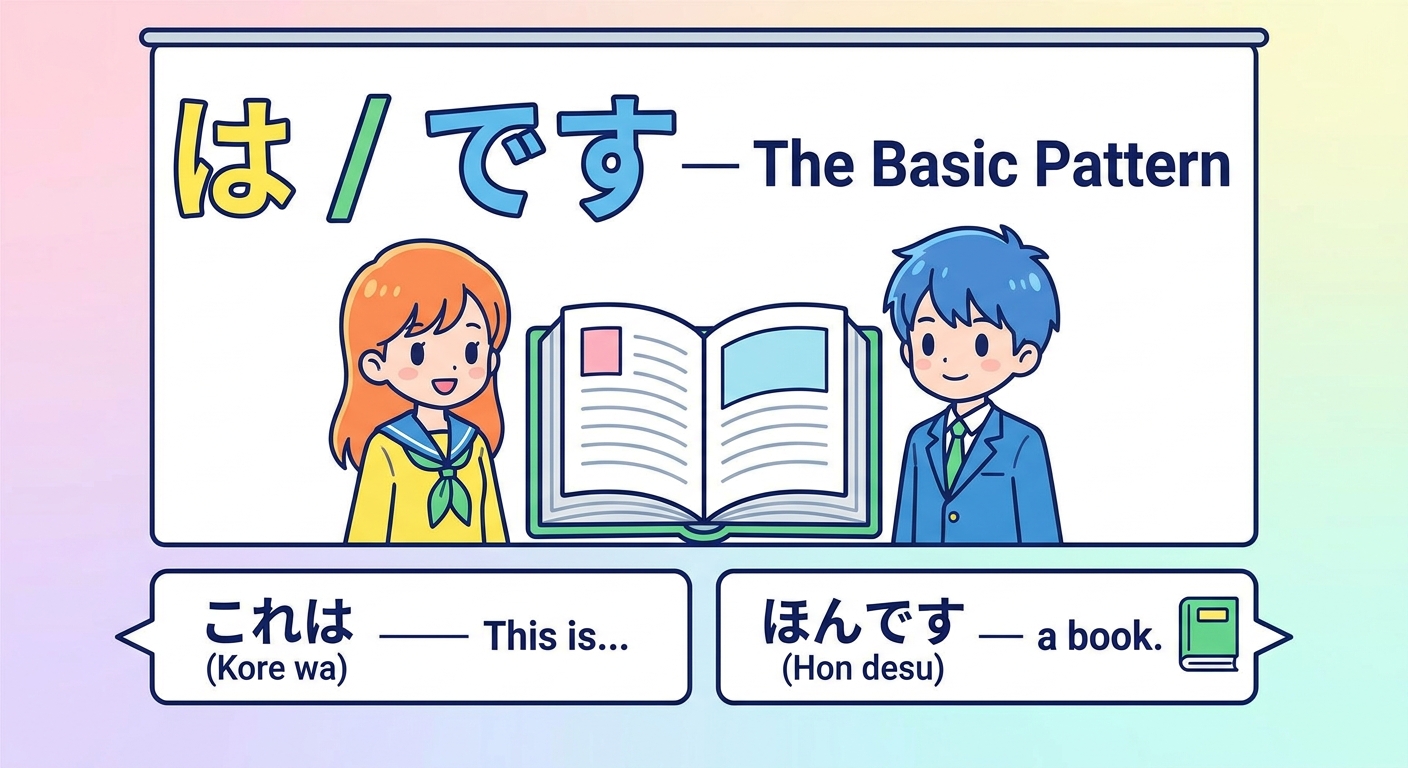
Introduction
Welcome to your very first step in mastering Japanese grammar! In this lesson, we introduce the absolute foundation of Japanese sentence structure: the "A は B です" (A wa B desu) pattern. This essential formula allows you to identify people, describe objects, and state facts—equivalent to saying "A is B" in English. We will demystify the topic marker particle "は" (pronounced 'wa') and the polite copula "です" (desu). By mastering this simple yet powerful structure, you will unlock the ability to introduce yourself, share your nationality, state your occupation, and begin speaking Japanese with confidence.
Lesson Content
Learning Goal
By the end of this lesson, you will be able to confidently construct basic Japanese sentences using the "A は B です" pattern to introduce yourself, state your profession or nationality, and identify everyday objects.
Concept
Japanese sentence structure is fundamentally different from English. Instead of "A is B," Japanese uses A は B です (A wa B desu). The key difference: Japanese places the verb (です / desu) at the very end of the sentence.
Think of this pattern as a simple formula:
- A = the topic (what you're talking about)
- は (wa) = the topic marker particle
- B = the description or identity
- です (desu) = the polite "is/am/are"
Step-by-Step Breakdown
1. The Particle は (wa)
The hiragana character は is normally pronounced "ha," but when used as a particle, it's pronounced wa.
- Function: Marks the topic of the sentence
- Think of it as: "Speaking of A... / As for A..."
2. The Copula です (desu)
です (desu) is the polite form of "to be." It never changes form for person or number:
- I am = です
- You are = です
- He/she is = です
- They are = です
Pronunciation tip: The "u" at the end is very soft—almost silent. Say "dess" with a slight "u" at the end.
3. Complete Sentence Structure
Pattern: A は B です (A wa B desu) = A is B
Mini Examples
Example 1: Self-Introduction
私は学生です。
- Watashi wa gakusei desu.
- I am a student.
Example 2: Nationality
私は日本人です。
- Watashi wa nihonjin desu.
- I am Japanese.
Example 3: Identifying an Object
これは本です。
- Kore wa hon desu.
- This is a book.
Example 4: Stating a Profession
私は先生です。
- Watashi wa sensei desu.
- I am a teacher.
Common Mistake
❌ Wrong: 私です学生 (Watashi desu gakusei)
- This puts です in the middle, like English word order.
✅ Correct: 私は学生です (Watashi wa gakusei desu)
- Always keep です at the end!
❌ Wrong: Pronouncing は as "ha" in this pattern
- Remember: When は is a particle, it's always "wa."
Quick Practice
Mini Drill 1: Fill in the blank
私は________です。 (I am a teacher.)
Answer: 先生 (sensei)
Mini Drill 2: Fill in the blank
これは________です。 (This is a book.)
Answer: 本 (hon)
Try creating these sentences:
- "I am Japanese." → 私は日本人です。
- "This is a student." → これは学生です。
Summary and Next Step
You've learned the most fundamental Japanese sentence pattern: A は B です (A wa B desu).
Key points to remember:
- は (wa) marks the topic
- です (desu) always comes at the end
- The pattern means "A is B"
Next step: In the next lesson, you'll learn how to make negative sentences (A は B ではありません) and ask questions (A は B ですか). You'll also expand your vocabulary to describe more people, objects, and places.
Exercises
は / です — The Basic Pattern (Exercises)
Exercises for は / です — The Basic Pattern
Review the grammar and vocabulary, and try to fill in the blanks or write sentences based on the prompts.
Examples
私は学生です。
Watashi wa gakusei desu.
I am a student.
これは本です。
Kore wa hon desu.
This is a book.
田中さんは先生です。
Tanaka-san wa sensei desu.
Mr. Tanaka is a teacher.
Practice Drills
Lesson Materials
Vocabulary (5)
Grammar (3)
Kanji (0)
No kanji characters in this lesson.
Kana (0)
No kana characters in this lesson.