
Small や・ゆ・よ Sounds
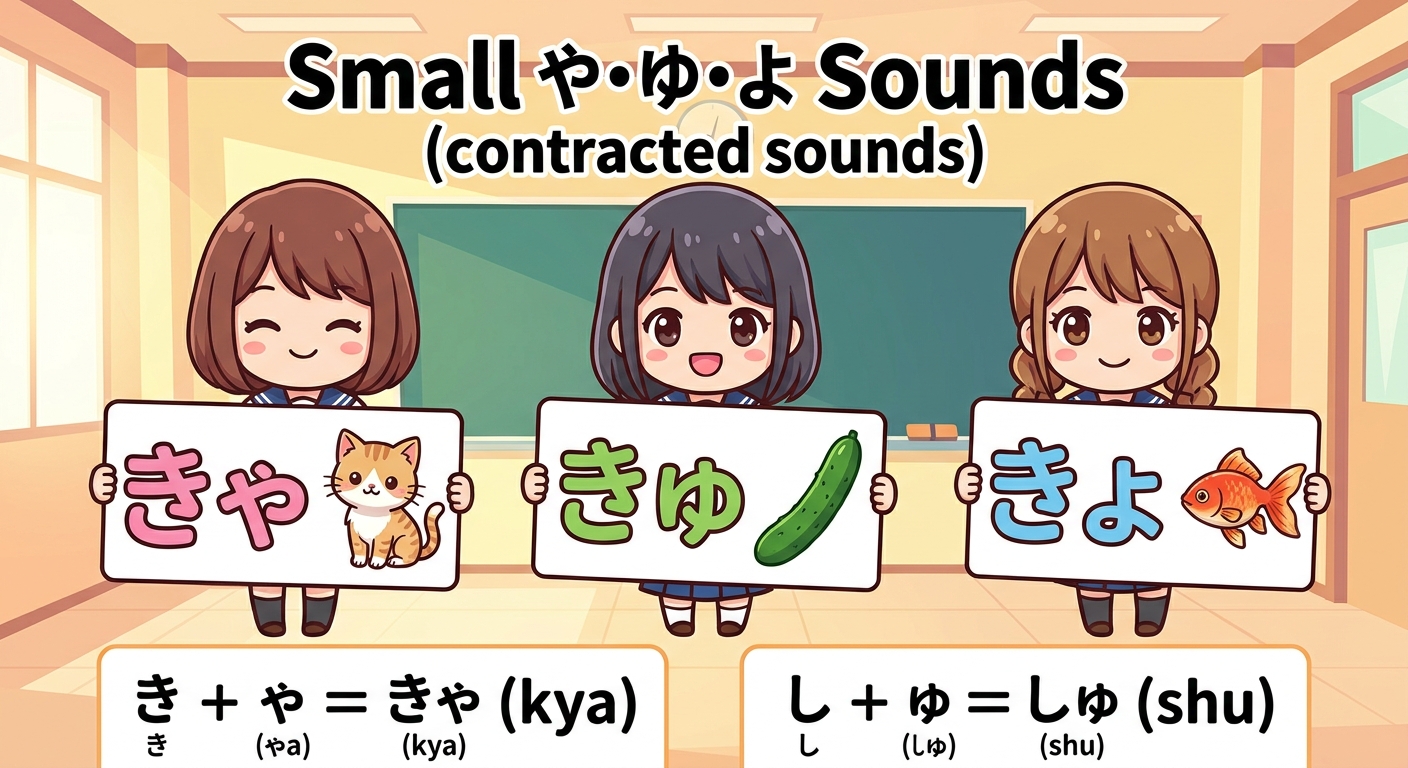
Learn how small や, ゆ, よ combine with い-row kana to form blended sounds like きゃ, しゅ, ちょ. Practice reading and writing 33 combination sounds.
🎯 Goal: By the end of this lesson, you will be able to identify, write, and accurately pronounce Hiragana combinations using small や, ゆ, and よ, allowing you to read and speak foundational N5 vocabulary with natural Japanese rhythm and pronunciation.
Introduction
Welcome to your guide on "Small や・ゆ・よ Sounds," known as Yōon (contracted sounds) in Japanese. As an N5 learner, mastering these sounds is a crucial step toward natural pronunciation and reading fluency. In Japanese, combining standard Hiragana characters ending in the "i" sound (like ki, shi, or chi) with a miniature ya, yu, or yo creates brand-new, single-syllable sounds like kya, shu, and cho. Understanding how to read, write, and pronounce these combinations correctly will help you avoid common pitfalls and speak Japanese with confidence. Let's dive in!
Lesson Content
Master Japanese Yōon: The "Small" や・ゆ・よ Sounds
Welcome to your ultimate guide to mastering Yōon (拗音), commonly known as the "small や (ya), ゆ (yu), よ (yo)" sounds.
At the JLPT N5 level, mastering these contracted sounds is vital. They completely change the meaning and pronunciation of words. Think of them as the "blends" of the Japanese language!
1. The Golden Rule of Formation
Contracted sounds are created using a simple mathematical formula:
$$\text{Any } [i]\text{-row Kana (except い)} + \text{Small } ゃ / ゅ / ょ = \text{One New Sound}$$
The "I-Row" Candidates:
To make these sounds, you can only use Hiragana from the second column ($[i]$-row) of the Hiragana chart:
- き (ki), し (shi), ち (chi), に (ni), ひ (hi), み (mi), り (ri)
- This also includes their voiced (dakuten) versions: ぎ (gi), じ (ji), び (bi), ぴ (pi)
The Formula in Action:
When you attach a small ゃ, ゅ, or ょ, the vowel sound of the first character ($[i]$) drops, and it blends directly into the $Y$-sound.
$$\text{き (ki)} + \text{ゃ (small ya)} \rightarrow \text{きゃ (kya)} \quad [\text{Not } \textit{ki-ya}]$$
2. Pronunciation & The "One-Beat" Rule
In Japanese, timing is everything. Each standard character takes up one beat (mora) of time.
- Standard size: きや (ki-ya) = 2 beats
- Small size: きゃ (kya) = 1 beat
If you mispronounce the timing, you will say a completely different word!
The Ultimate Comparison:
| Japanese | Romaji | Beats | Meaning |
|---|---|---|---|
| じゆう (じ・ゆ・う) | ji-yu-u | 3 beats | Freedom |
| じゅう (じゅ・う) | ju-u | 2 beats | Ten (10) |
| びよういん (び・よ・う・い・ん) | bi-yo-u-i-n | 5 beats | Beauty Salon |
| びょういん (びょ・う・い・ん) | byo-u-i-n | 4 beats | Hospital |
3. High-Frequency N5 Vocabulary Chart
Here are key N5 words utilizing these contracted sounds. Practice reading them aloud, paying close attention to the blended sound.
| Kana | Romaji | English | Breakdown |
|---|---|---|---|
| お茶 (おちゃ) | o-cha | Green tea | ち (chi) + ゃ (ya) = ちゃ (cha) |
| 辞書 (じしょ) | ji-sho | Dictionary | し (shi) + ょ (yo) = しょ (sho) |
| 電車 (でんしゃ) | den-sha | Train | し (shi) + ゃ (ya) = しゃ (sha) |
| 今日 (きょう) | kyo-u | Today | き (ki) + ょ (yo) = きょ (kyo) |
| 旅行 (りょこう) | ryo-ko-u | Travel | り (ri) + ょ (yo) = りょ (ryo) |
| 牛乳 (ぎゅうにゅう) | gyu-u-nyu-u | Milk | ぎ (gi)+ゅ (yu) / に (ni)+ゅ (yu) |
4. How to Write Them Correctly
Visual clarity is essential. If your handwriting is messy, a native speaker will read your small ゃ as a big や.
- Size: The small ゃ, ゅ, ょ should be approximately $1/4$ the size of the character preceding it.
- Positioning:
- Horizontal writing (横書き): Position the small character in the bottom-left of the imaginary character grid square.
- Vertical writing (縦書き): Position the small character in the top-right of the square.
5. Quick Check Challenge!
Test your understanding. Romaji-fy the following N5 sentences (Answers below):
- おちゃを飲みます。 (I drink green tea.)
- ひゃく円です。 (It is 100 yen.)
- きょねん、日本に行きました。 (I went to Japan last year.)
- O-cha o nomimasu.
- Hya-ku en desu.
- Kyo-nen, Nihon ni ikimashitā.
Exercises
Small や・ゆ・よ Sounds (Exercises)
Exercises for Small や・ゆ・よ Sounds
Review the grammar and vocabulary, and try to fill in the blanks or write sentences based on the prompts.
Examples
今日はお茶を飲みます。
Kyō wa ocha o nomimasu.
I will drink green tea today.
電車で会社に行きます。
Densha de kaisha ni ikimasu.
I go to the office by train.
病院はどこですか。
Byōin wa doko desu ka.
Where is the hospital?
Practice Drills
Lesson Materials
Vocabulary (5)
Grammar (0)
No grammar rules in this lesson.
Kanji (0)
No kanji characters in this lesson.
Kana (0)
No kana characters in this lesson.