
People + Places Kanji
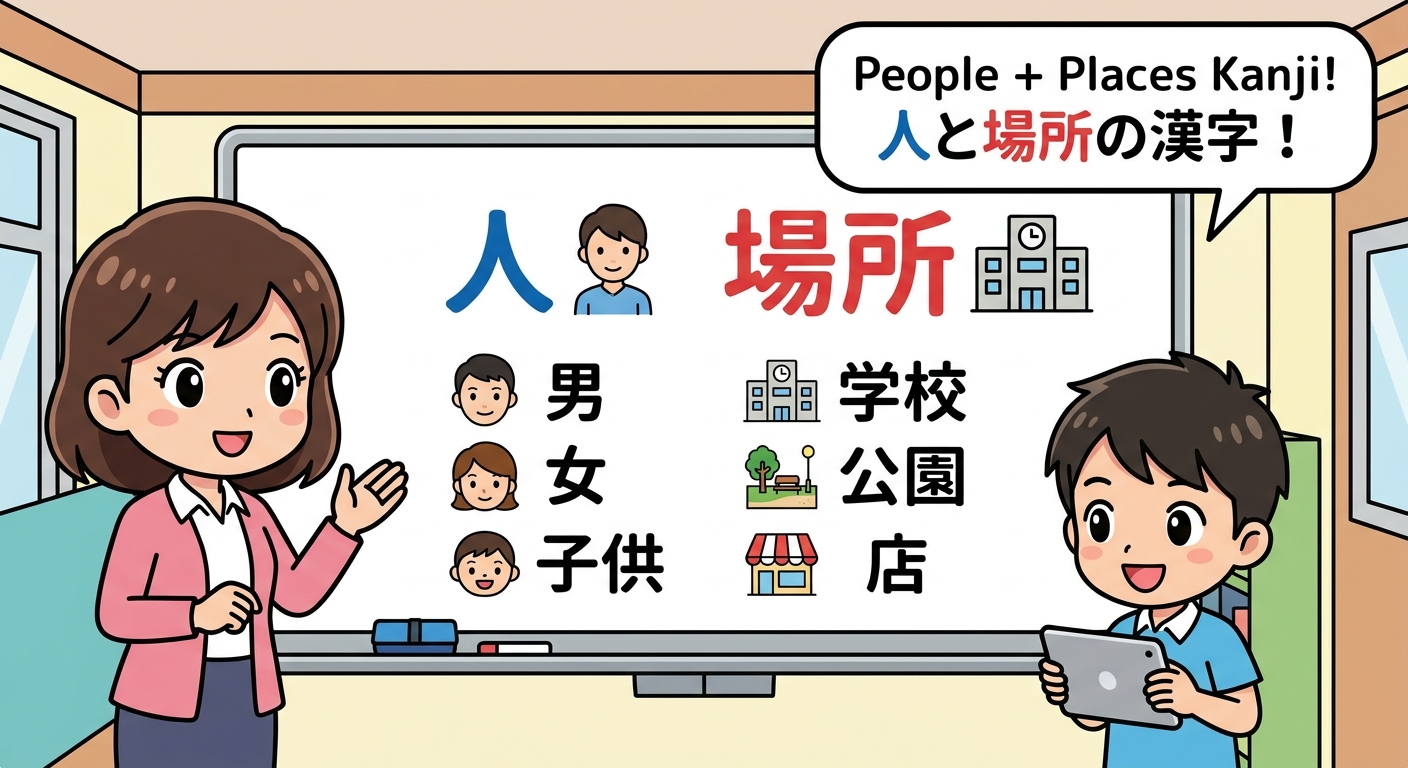
Learn 9 kanji related to people and places: 人子女男先生学校駅国. Connect readings to vocabulary already learned.
🎯 Goal: To master the reading, writing, and recognition of key N5 kanji related to people and locations, enabling you to identify them in daily contexts and use them accurately in basic sentences.
Introduction
Welcome to your essential guide to foundational Japanese kanji! In this lesson, we will explore the core characters used to describe people and places—the very building blocks of everyday communication in Japan. Mastering these N5-level kanji, such as 人 (person), 先 (before), and 国 (country), will instantly boost your reading comprehension and help you navigate Japanese environments with confidence. We will break down the stroke order, readings (Onyomi and Kunyomi), and common compound words for each character. By connecting these symbols to visual concepts of people and the world around them, you will build a solid foundation for your Japanese language journey.
Lesson Content
Master N5 Kanji: People & Places
Welcome to your ultimate JLPT N5 Kanji guide! Today, we are exploring seven essential Kanji representing people and places. In Japanese, Kanji are not just letters; they are ideograms—pictures that represent ideas.
By mastering these seven characters, you will unlock the ability to read basic Japanese names, signs, and map locations.
Part 1: The "People" Kanji (人, 女, 子)
1. 人 (Person / Human)
- Stroke Count: 2
- Readings:
- Kunyomi (Native): ひと (hito)
- Onyomi (Chinese): ジン (jin), ニン (nin)
- Mnemonic: A simple drawing of a person walking on two legs.
- Key Vocabulary:
- あの人 (ano hito) — That person
- 日本人 (nihonjin) — Japanese person (Country + 人)
- 三人 (sannin) — Three people
2. 女 (Woman / Female)
- Stroke Count: 3 (Pay attention to stroke order: start with the angled stroke
く, then the diagonal, and finish with the horizontal line across). - Readings:
- Kunyomi: おんな (onna)
- Onyomi: ジョ (jo)
- Mnemonic: A woman bowing or dancing gracefully with her arms crossed.
- Key Vocabulary:
- 女の人 (onna no hito) — Woman
- 女の子 (onna no ko) — Girl
3. 子 (Child)
- Stroke Count: 3
- Readings:
- Kunyomi: こ (ko)
- Onyomi: シ (shi)
- Mnemonic: A baby wrapped in a swaddling blanket with arms outstretched.
- Key Vocabulary:
- 子ども (kodomo) — Child
- 男の子 (otoko no ko) — Boy
Part 2: The "Places & Nature" Kanji (山, 川, 田, 国)
These four Kanji are incredibly common in Japanese geography and family surnames.
| Kanji | Meaning | Kunyomi (Native) | Onyomi (Chinese) | Mnemonic Hint |
|---|---|---|---|---|
| 山 | Mountain | やま (yama) | サン (san) | Three peaks of a mountain. |
| 川 | River | かわ / がわ (kawa/gawa) | セン (sen) | Three flowing streams of water. |
| 田 | Rice Field | た / だ (ta/da) | デン (den) | A bird's-eye view of a divided farming plot. |
| 国 | Country | くに (kuni) | コク / ゴク (koku/goku) | A king (玉) protected inside a border (囗). |
Key Vocabulary:
- 富士山 (fujisan) — Mt. Fuji
- 山田さん (yamada-san) — Mr./Ms. Yamada (A very common surname: Mountain + Rice Field)
- 小川 (ogawa) — Stream / Brook (Small + River)
- 外国 (gaikoku) — Foreign country (Outside + Country)
Part 3: Grammar Integration & Particles
Let’s see how these Kanji function in N5 sentences using essential particles.
Pattern 1: Describing a Person's Nationality
[Country] + 人 + です
- Example: 彼はイギリス人です。
- Romaji: Kare wa igirisujin desu.
- English: He is British.
- Grammar Note: The topic marker は (wa) identifies the subject, and adding 人 (jin) to a country name denotes nationality.
Pattern 2: Locating a Person in a Place
[Place] + に + [Person] + が います
- Example: 山に女の子がいます。
- Romaji: Yama ni onna no ko ga imasu.
- English: There is a girl in the mountain.
- Grammar Note: The particle に (ni) marks the location, while が (ga) introduces the subject before the verb of existence います (imasu) (used for living things).
Quick Challenge!
Can you translate this sentence into Japanese using our new Kanji?
"Mr. Yamada is returning to his country."
Answer:
山田さんは国に帰ります。
(Yamada-san wa kuni ni kaerimasu.)
Exercises
People + Places Kanji (Exercises)
Exercises for People + Places Kanji
Review the grammar and vocabulary, and try to fill in the blanks or write sentences based on the prompts.
Examples
あの人は日本人です。
Ano hito wa nihonjin desu.
That person is Japanese.
駅で友達に会います。
Eki de tomodachi ni aimasu.
I will meet my friend at the station.
電車で学校に行きます。
Densha de gakkou ni ikimasu.
I go to school by train.
Practice Drills
Lesson Materials
Vocabulary (5)
Grammar (3)
Kanji (13)
Kana (0)
No kana characters in this lesson.